Resources to use with your team this week.
Practitioner-grade frameworks and tools for developing AI capability in people and organizations. Built from real operating experience, not theory. All free.
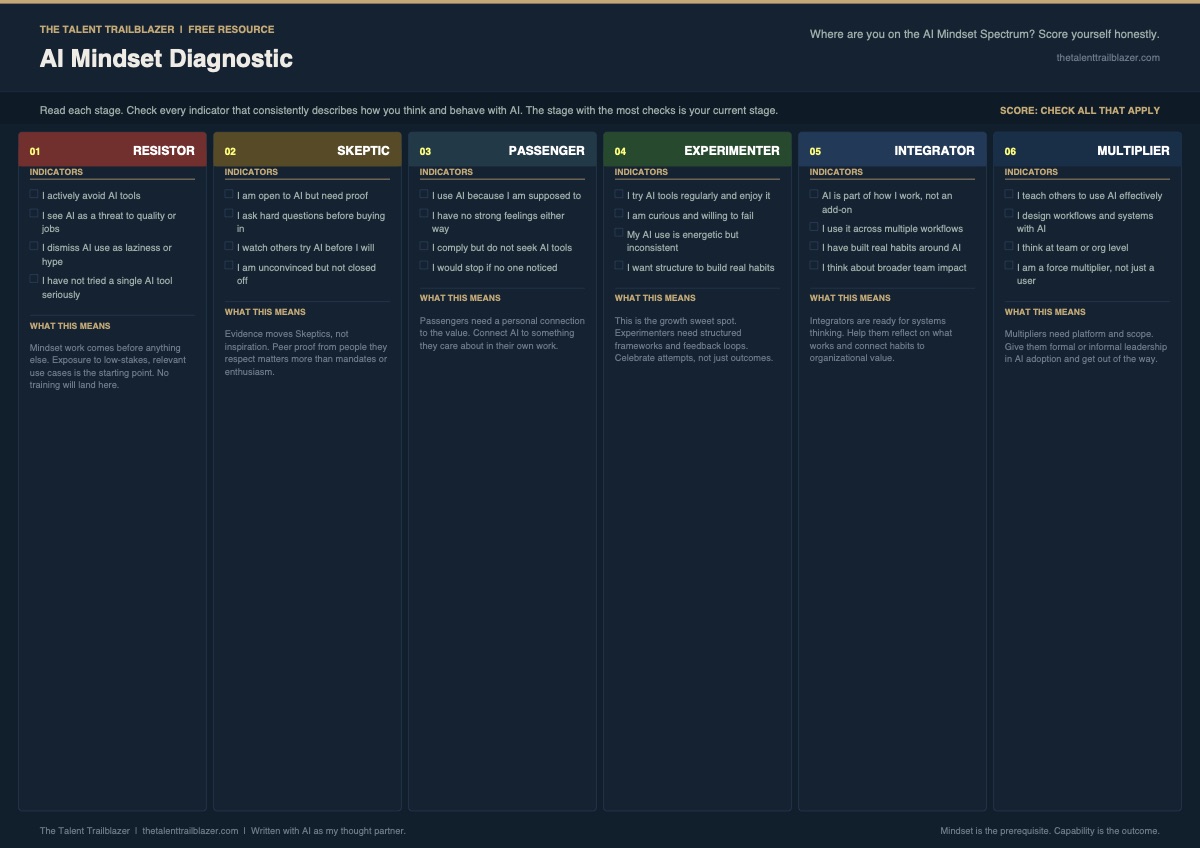
AI Mindset Diagnostic
This is not a quiz. It is a mirror. Check every indicator that consistently describes how you think and behave with AI. The stage with the most checks is your current stage.
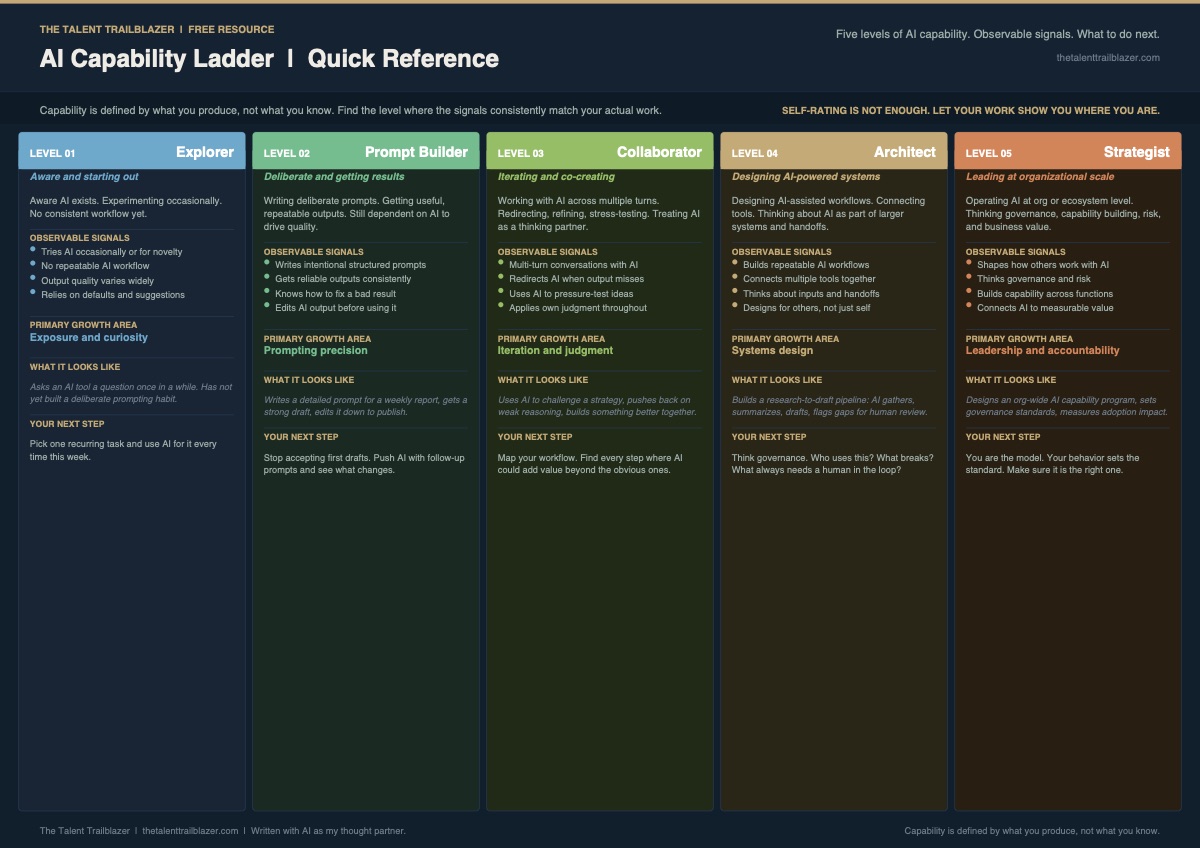
AI Capability Ladder Quick Reference
Capability is defined by what you produce, not what you know. Find the level where the signals consistently match your actual work.
Explorer
Aware AI exists. Experimenting occasionally. No consistent workflow yet.
Observable signals
- Tries AI occasionally or for novelty
- No repeatable AI workflow
- Output quality varies widely
- Relies on defaults and suggestions
Primary growth area
Exposure and curiosity
What it looks like
Asks an AI tool a question once in a while. Has not yet built a deliberate prompting habit.
Your next step
Pick one recurring task and use AI for it every time this week.
Prompt Builder
Writing deliberate prompts. Getting useful, repeatable outputs. Still dependent on AI to drive quality.
Observable signals
- Writes intentional structured prompts
- Gets reliable outputs consistently
- Knows how to fix a bad result
- Edits AI output before using it
Primary growth area
Prompting precision
What it looks like
Writes a detailed prompt for a weekly report, gets a strong draft, edits it down to publish.
Your next step
Stop accepting first drafts. Push AI with follow-up prompts and see what changes.
Collaborator
Working with AI across multiple turns. Redirecting, refining, stress-testing. Treating AI as a thinking partner.
Observable signals
- Multi-turn conversations with AI
- Redirects AI when output misses
- Uses AI to pressure-test ideas
- Applies own judgment throughout
Primary growth area
Iteration and judgment
What it looks like
Uses AI to challenge a strategy, pushes back on weak reasoning, builds something better together.
Your next step
Map your workflow. Find every step where AI could add value beyond the obvious ones.
Architect
Designing AI-assisted workflows. Connecting tools. Thinking about AI as part of larger systems and handoffs.
Observable signals
- Builds repeatable AI workflows
- Connects multiple tools together
- Thinks about inputs and handoffs
- Designs for others, not just self
Primary growth area
Systems design
What it looks like
Builds a research-to-draft pipeline: AI gathers, summarizes, drafts, flags gaps for human review.
Your next step
Think governance. Who uses this? What breaks? What always needs a human in the loop?
Strategist
Operating AI at org or ecosystem level. Thinking governance, capability building, risk, and business value.
Observable signals
- Shapes how others work with AI
- Thinks governance and risk
- Builds capability across functions
- Connects AI to measurable value
Primary growth area
Leadership and accountability
What it looks like
Designs an org-wide AI capability program, sets governance standards, measures adoption impact.
Your next step
You are the model. Your behavior sets the standard. Make sure it is the right one.
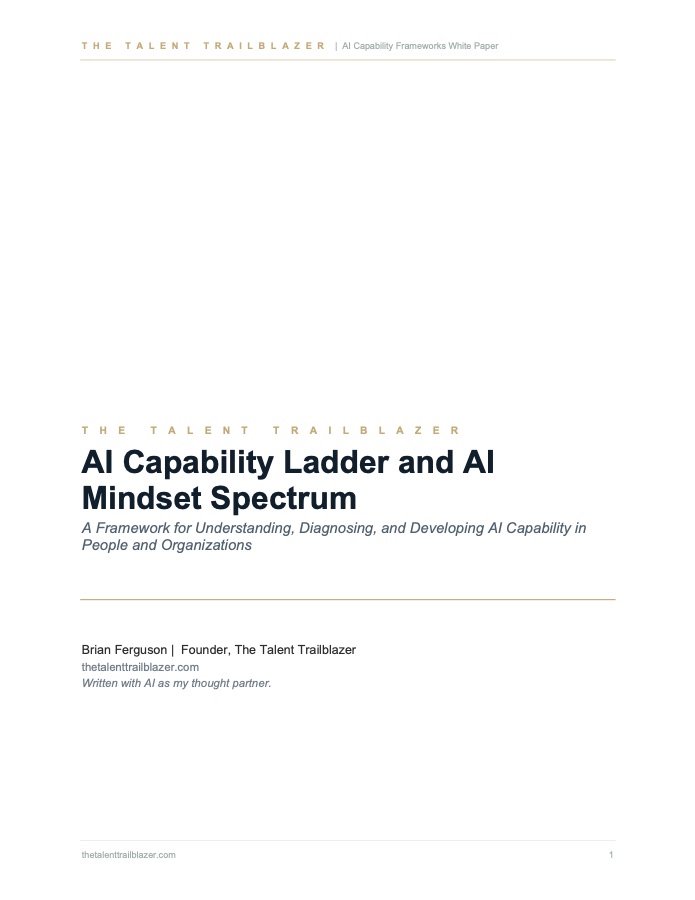
AI Capability Ladder and AI Mindset Spectrum: the white paper
Most AI development programs fail before they start. Not because of the tools. Not because of the content. Because they treat mindset and capability as the same thing.
- 1The Problem with How Organizations Approach AI Development
- 2The AI Capability Ladder
- 3The AI Mindset Spectrum
- 4How the Frameworks Work Together
- 5Applying These Frameworks in Practice
- 6Reflection Guide: Speaking to the Frameworks Clearly
- 7What These Frameworks Are and Are Not